
Dall’elettronica all’atomtronica: nuove prospettive per le tecnologie quantistiche
January 7, 2026
Oscar of Science 2026: CNR‑INO researchers at the heart of the Muon g‑2 experiment
April 21, 2026
On 15–16 December 2025, the Annual Symposium of CNR-INO was held at the CNR Research Area in Florence. This yearly event brings together researchers from the National Institute of Optics.
With several PNRR-funded projects approaching completion in 2026, Director Paolo De Natale introduced an innovative format, inviting representatives from academia, industry, and institutions.
The 2025 edition, entitled “Beyond PNRR. Connecting in the New R&D Ecosystem,” was conceived as a space for dialogue and for building synergies among CNR-INO, universities, other research organisations, and the business sector. The aim was to enhance and collaboratively continue the work initiated under the PNRR framework. Central to the discussion was the role of the CNR and other key actors in the emerging Italian research ecosystem, operating in a context of profound transformation and redefinition of national and European strategies to foster innovation and long-term impact.
A rich program combining scientific presentations and strategic perspectives opened on 15 December with institutional greetings from the Director of CNR-INO, Paolo De Natale, who stated: “Major investments made possible by the PNRR must open up new and highly significant opportunities, but it is interdisciplinarity and complementarity that will generate real progress and tangible innovation.”
The first sessions, dedicated to CNR-INO’s main research areas, gave voice to early-career researchers, offering a fresh and innovative perspective on the Institute’s activities. The first day concluded with the poster session and a dinner at LENS—an informal and well-attended moment that fostered interaction and dialogue among researchers, PhD students, and scientific partners.
A Space for Debate: Four Round Tables on the Present and Future of Research
The symposium’s round tables formed the core of the strategic discussion, providing a platform for dialogue among researchers, institutions, and research policymakers in a context marked by the transition beyond the PNRR.
The first round table, focused on European and national PNRR strategies, offered a comparison between the Brussels and Italian perspectives. Contributions from experts in European research policy (Anna Pelagotti, Lorenzo Tombaresi, Angelo Volpi, and Francesca Galli) highlighted the urgent need for closer alignment between national priorities and European objectives. They emphasised that structured dialogue between PNRR networks and the European vision is essential to strengthen Italy’s positioning within the European Research Area.
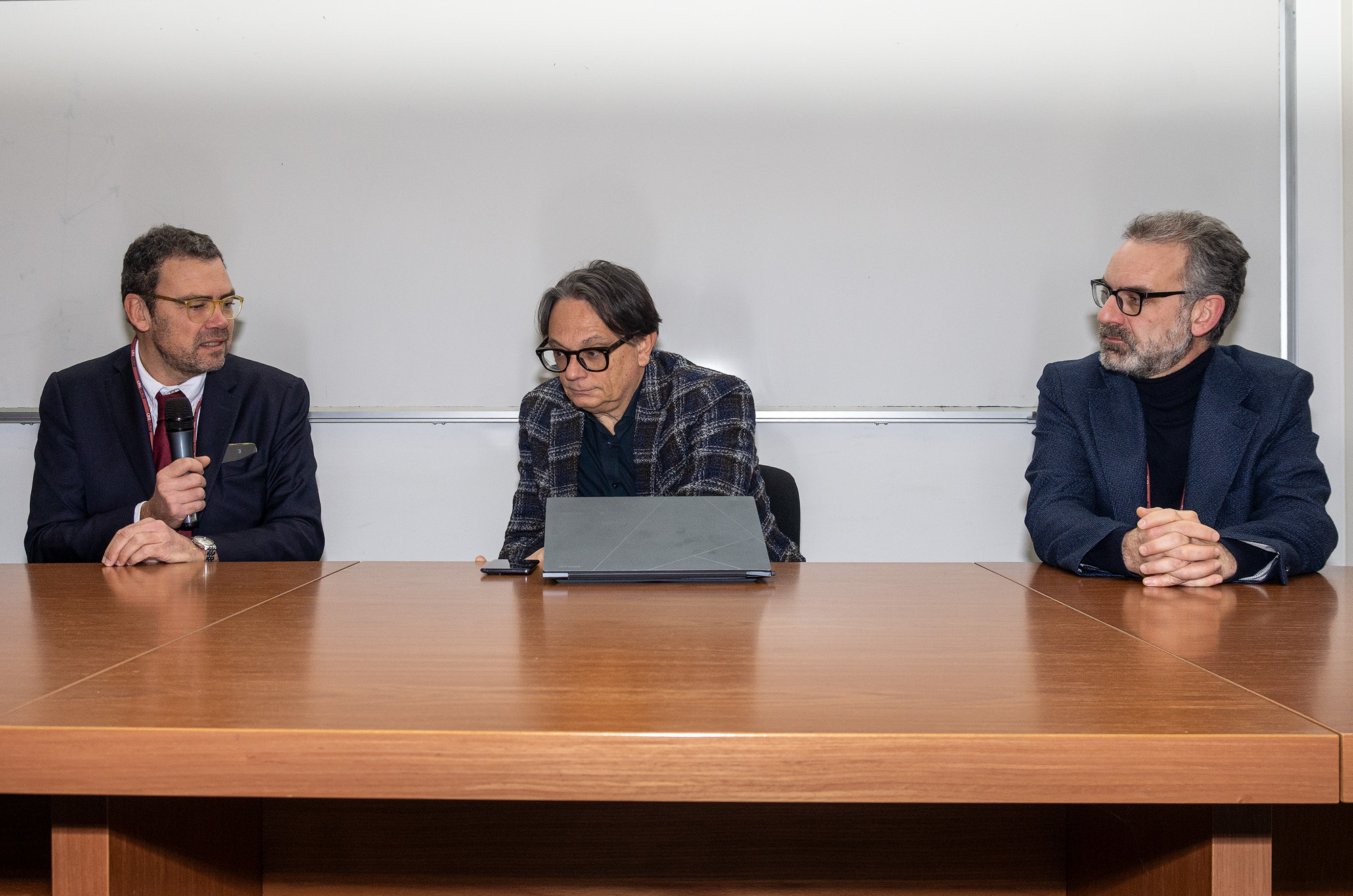
Round table panel: Paolo De Natale (Moderator, Director of CNR-INO), Anna Pelagotti (CNR Liaison Officer in Brussels), Lorenzo Tombaresi (CNR Liaison Officer in Brussels), Angelo Volpi (CNR-ICMATE, Milan), Francesca Galli (MUR, Head of Unit).
The second round table focused on Research Infrastructures and Innovation Ecosystems, illustrating how the PNRR is creating new opportunities to consolidate the country’s technological and innovative capacity. Contributions from CNR researchers involved in major research infrastructures highlighted their role as strategic nodes within an increasingly connected national network with strong international appeal.
Round table Panel: Nicole Fabbri (Moderator, CNR-INO), Paolo De Natale (PI PNRR RI I-PHOQS, Director, CNR-INO), Raffaella Fontana (CNR-INO, Florence), Leonida Gizzi (PNRR RI EuAPS & IE THE, CNR-INO, Pisa), Francesca Spataro (PNRR RI EBRAINS-Italy, CNR-IBF, Palermo), Ugo Cortesi (Co-PI PNRR RI EMM, CNR-IFAC, Sesto Fiorentino).
The discussion continued with a session dedicated to Extended Partnerships and National Centres, highlighting CNR-INO’s commitment to strengthening synergies, integrating expertise, and ensuring project continuity—key elements for achieving long-term impact and sustainability.
Round table Panel: Luca Peruzzi (Moderator, Journalist), Stefano Fabris (Director, CNR-DSFTM), Alessandro Iafrati (Director, CNR-INM – PNRR MOST), Aldo Di Carlo (Director, CNR-ISM – PNRR PE NEST), Andrea Passerella (Director, CNR-IIT – PNRR PE SERICS & PE RESTART).
The final round table, focused on CNR-INO’s institutional activities, provided an internal perspective on evolving processes and organisational challenges linked to the increasing project complexity generated by the PNRR.
Round table Panel: Alessandro Farini (Moderator, CNR-INO, Florence), Elisabetta Baldanzi (Outreach), Andrea Sordini (Computing & Network Systems), Roberta Parenti (Procurement of Goods and Services), David Jafrancesco (Safety).
Taken together, the round tables conveyed a clear message: CNR-INO is now a central actor in the new Italian research ecosystem, increasingly integrated at the European level and oriented towards a long-term strategic vision.
The 2025 Symposium confirmed INO’s central role within the Italian research landscape, highlighting its ability to act as a bridge between science, technology, and policy, and to contribute significantly to the development of the country’s new R&D ecosystem.